Saying Goodbye to tweeting

Just to officially note, as of today, I’m closing 4 Horizons former Twitter account, @4horizonsmike.

With luck, perhaps someday, we can find a way to create more positive online spaces, though I remember inconsiderate and nasty people even on local BBSs in the 1990s.

Are clicks all there is?

Why are so many websites cluttered with ads when hosting is so cheap? Is “passive income” really something to be proud of?

Isn’t there something more meaningful to do than design advertising platforms, monetizing what people click on, building dossiers on their preferences to target even more ads to them?

What if we focus on something beyond the next killer product?

Jason Hiner from ZDNet asks these kinds of questions: Who will have the courage to build the future again?

Remembering Steve

Steve Jobs’s vision lit the path of my life. Today’s personal computers, not just Apple’s computers, would not exist without his drive and vision. Those computers have accompanied me from childhood, through school, and into my career and my personal life, enriching what and who I am today.

My parents and Uncle Dave bought me my first computer, an Apple IIgs, when I was eight years old. Even before that, I’d spent many hours on the Apple computers at school, playing with Oregon Trail, Lemonade Stand, Where in the USA is Carmen Sandiego?, Math Blaster, and Print Shop Pro.

Demonstrating how to make a sign using Print Shop Pro on an Apple IIe led to my first job as an unpaid co-host on a teen-focused local TV show named Fast Forward. I switched to MS-DOS and Windows 3.1 for middle school and high school, but asked for an Apple PowerBook 5300c to take to college (thanks again Mom and Dad).

During college, an ex would only use Windows, so I switched back to Microsoft. By then, I became flexible in what systems I used, finding the commonalities and differences. These were real skills for entering the workforce. Indeed, it wasn’t my history degree that led to a paycheck, but being comfortable with technology. This comfort culminated in an MCSE (Microsoft Certified Systems Engineer) credential for designing and supporting IT infrastructure.

I ordered a 13 inch G4 PowerBook for work in 2004. Its portability and capability—at the time, few small laptops included a DVD burner, let alone easy-to-use video editing software—let me eliminate overpriced production houses for cutting and duplicating a few videos. It was also my first exposure to Mac OS X (sorry Steve, it sounds better as “O.S. X” not “O.S. Ten”), which was sleeker and more stable than the Windows servers and PCs I supported.

Today, I run 4 Horizons on a 2008 unibody MacBook, still running strong after almost three years with a recent RAM upgrade.

And there’s my iPhone 4. It is a phone, but also a communication and information portal, a guide and map when I’m lost, a portable photo album, a way to chat, talk, and email nearly anywhere. This is technology far more advanced than a full-fledged computer a decade ago and it fits in my back pocket. It was on my iPhone, so recently eclipsed by the 4S last week, where my coworker texted me that Steve had died.

I am an IT professional to make my living. I met my partner of thirteen years online on that PowerBook 5300, still sitting in a plastic tub in the basement, and continue to meet people from all over the world via the virtual spaces my devices connect me to.

Apple and Steve Jobs helped nurture a love of technology in me, what it enables people to create, connect, and learn. This is part of Steve’s vision of technology expanding our horizons. He inspired through his words (viewable below) and gave resources and tools so that creative people from John Lasseter at Pixar to millions of designers, writers, and artists could enrich our lives.

Thank you, Steve. Enjoy your well-earned access to all the knowledge of the Universe without worrying about processor speeds or Internet bandwidth or media company contracts.

And for the rest of us? Keep thinking different. Keep searching for work that means something. Keep trying to change the world, not by argument, but by creating and embodying our vision of what the world can be.
Job Blogging

I wanted to review what’s been happening since the end of July. Last month, I accepted a temporary job as a technical support representative at a call center. I learned what it’s like to help people over the phone while being measured against using standard scripts and call duration.

Let me put it this way: I have much more respect for the people who work the other end of those 1-800 support lines. It is tough work in an unforgiving environment with limited options to solve customers’ problems.

I have moved on from that position, however, and am enjoying the challenges of my new job providing IT support to a community business in southeast Michigan.

You may have noticed the lack of specificity about where I worked at the call center and since. In part, that is due to confidentiality requirements.

I will continue to blog on occasion about technology, books, movies, and other topics as I can. I am still available for consulting work and freelance writing, but I would need to evaluate that work to avoid any potential conflicts of interest and if the scope of the project fits in with my work schedule.

That said, I want to thank everyone who’s followed this blog. Stay tuned for updates as they arise.

Presentation Zen

As part of my mediation training via Schoolcraft College, I’ve sat through eighty-eight hours for three courses so far. Much of this time has included a PowerPoint presentation projected on a screen next to a podium at the front of the room.

Businesses, organizations, and schools use computer presentation software like PowerPoint in every type of meeting. I’ve made a few myself and set up equipment for many more. Most people use built-in or downloadable templates with tons of bullet point lists, perhaps broken up with a full-slide picture or graph now and then.

Garr Reynolds’s Presentation Zen (Amazon, presentationzen.com) focuses on the key questions to create meaningful presentation experiences:

  • Who is in your audience?
  • What does your audience know? What do they need to know that you can share with them?
  • Is presentation software the right tool for what you’re communicating?
  • What are you trying to say anyway?
  • Think about why you put certain things on the slide, into your talk, and in leave-behind materials for your audience?

The book then steps forward with practical suggestions to conceptualize a presentation as a whole and how to design individual slides to support your message.

Garr summarized his book in this video and went into greater detail during a lunch hour talk at Google.

You can also get a complimentary approach to presenting in this post from Seth Godin’s blog.

After sifting through all this material, I realized that I can help people write better content for slides, speaker’s notes, and other materials as well as design simple, clear presentations from the ground up. 4 Horizons will offer freelance presentation assistance going forward using Presentation Zen principles.

So, thank you, Garr, for bringing together vital ideas about achieving real communication with others. It’s not PowerPoint that sucks (per se); it’s relying on software to bluff your way through the hard work of real communication.

Ozark Survival Tool: A Tick Crowbar

An important survival tool that I was reminded of during my weekend stay in the Missouri Ozarks last week: a tick puller.

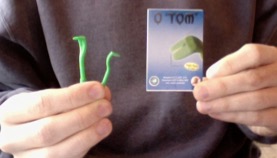
tickpuller

This is the best tool for removing ticks. Unlike tweezers, you don’t need good aim and fine motor control, especially necessary for seed ticks the size of a pencil dot. Unlike plucking them off with your fingers, you don’t have to touch the tick directly. Unlike using petroleum jelly, gasoline, rubbing alcohol, or fire to get ticks to let go, the tick pullers get them out without trauma, avoiding the tick vomiting back into your body and causing infection.

After about a month of searching with no luck in the midst of a vicious tick onslaught last spring, I found these at Sunshine Market in Mountain View, Missouri for $3.50. Search for them online. The manufacturer’s website is otom.com. They are well worth it!

Ozark tip of the day: check for ticks, all over, at least before bed everyday. Use a flashlight. If you feel something on your skin check it; if you remove a tick before it bites, so much the better for you. In other words, get those suckers before they get you.

Seth Godin’s Linchpin: Work in a Factory or Create Something Meaningful

The only work worth doing has no roadmap, no guidance for success, and is not made to be marketable. In other words, according to author and blogger Seth Godin, your real work in life is making art.

Art is not necessarily something painted or sculpted or written. You can exhibit your art in any job by expressing yourself and connecting with those you encounter. If you perform these expressions and connections in a genuine manner, giving of yourself without expectation of return, you can inspire others to new understandings of themselves and the world.

Create art, make connections, and inspire change and you will become a linchpin—a part on which an enterprise depends and cannot easily replace.

The alternative is to be a cog in the machine, doing a job with specifications, directions, and no responsibility for the overall outcome. On the upside, you’ll get paid for your time regardless of how much you improve a company’s profits (or deepen its losses). On the downside, cogs, doing jobs set out for them, are easily replaced. Consequently, cogs have no real job security and make little money.

Linchpins are leaders and inspire others, but this happens by example, not by policy:

You can’t say, ‘Get more excited and insightful or you’re fired.’ Actually, you can, but it won’t work. The front-desk worker at a hotel who runs out in the middle of the night to buy gym shorts for a guest isn’t doing it out of fear of being reprimanded. He does it because he was inspired to do so by a leader who wasn’t even in the hotel when the clerk decided to contribute (Linchpin, p. 221).

Working without guidelines? Encouraging people to perform without metrics to determine raises, promotions, or continued employment? These are foreign, even threatening, concepts to most employers and most labor organizations. They will lose control. Without control, they will cease to be relevant because both are designed to keep workers from being independent or self-reliant.

Godin explores many facets of the issues he raises. What stops people from expressing their art? A concept named “resistance” that Godin roots in the fight-or-flight response of human’s primitive “lizard brain,” the limbic system (pp. 109–110).

How is our innate creativity stomped out to prepare us for cog-style work in a factory—which have both blue and white collar uniforms? Godin offers an insightful critique of the US’s education system that prepares students for a life of compliance to established systems and acceptance of materialism to salve the hurt of limited choices in our work (pp. 39–48).

The twentieth century’s economic expansion—more goods produced more efficiently and sold to wide swaths of consumers at ever-lower prices—has reached its end. If you want work that has meaning, that engages you fully, and that continues regardless of economic conditions or a company’s shifting direction, then you need to become a linchpin.

In sum, linchpins:

  • express their art in spite of resistance
  • give of themselves to others without expecting reciprocity
  • see the world as it truly is from many different perspectives
  • don’t attach their hopes (energy) to a specific future that may never be